



The International Executive MBA is designed to solve the most critical challenges faced by leaders like you in a globalised and constantly changing business env
 Blog
Blog
29 de June de 2026
Studying abroad in Spain: Everything you need to know for 2026
Sumario:
Studying abroad is the process by which a student moves to another country to pursue studies at recognized academic institutions outside their country of origin. According to UNESCO, international student mobility is close to seven million people worldwide. In addition, Spain is positioned among the most popular destinations thanks to the quality of its university system, the diversity of its programs, and the richness of its cultural environment. To study in Spain in 2026, it is necessary to plan ahead: choose a program and university, validate previous qualifications, prepare documentation, apply for a type D student visa, secure funding and accommodation, and adapt to the Spanish academic and cultural environment.
Spain has established itself as one of the most attractive destinations for those seeking high-level international education. This article explains in detail the essential steps, administrative requirements, academic options, and aspects of student life that every future international student should know. From degree recognition and visas to choosing accommodation and cultural integration, we cover the key points to make your international study experience successful and enriching. Keep reading and discover how to turn your plan to study abroad into a well-planned reality.
What studying abroad means and why choose Spain in 2026
Studying abroad goes far beyond obtaining a degree in another country: it means gaining a global perspective, developing intercultural skills and building an international professional network. Spain, in particular, brings together several factors that make it especially attractive in 2026: more than 80 recognized universities, a growing range of programs taught in English, competitive living costs compared to other European countries, and a strategic position as a gateway between Europe and Latin America.
The Spanish University System is integrated into the European Higher Education Area (EHEA), which ensures that degrees obtained are recognized throughout the European Union and in many other countries. In addition, institutions such as ENAE Business School regularly appear in QS World University Rankings and Forbes rankings, which supports their academic quality in the eyes of employers and international organizations.
From a labor market perspective, professionals with international experience are increasingly in demand. According to the 2024 Graduate Management Admission Council (GMAC) Global Employability Report, 89% of employers prefer to hire candidates with education or experience abroad, making the decision to study abroad a strategic career investment.
Academic opportunities for studying abroad in Spain
Types of degrees: bachelor’s, master’s, and doctorate
The Spanish university system offers three levels of education adapted to different profiles and career stages. Bachelor’s degrees usually last four years, equivalent to 240 ECTS credits. University master’s degrees last between one and two years, equivalent to 60-120 ECTS credits, and allow students to specialize in specific areas. They are the most common entry route for international students who already hold a degree. Doctoral programs require an additional three to four years and are focused on advanced research.
There are also double degree programs with foreign universities, joint degrees and short specialization courses, expanding the options for those seeking flexible or combined training.
Leading universities and programs in English
The number of programs taught in English has grown significantly over the last five years. Business schools such as ENAE offer master’s and postgraduate programs entirely in English, especially in areas such as business, finance, technology, and social sciences. This trend facilitates access for students who do not yet master Spanish, as well as for professionals with an international outlook in global markets.
Professional internships and university-business agreements
One of the most valued assets of the Spanish education system is its connection with the business sector. Many programs include compulsory or voluntary professional internships integrated into the study plan, managed through agreements between the university and local or multinational companies. These internships allow students to apply their knowledge in real environments, build a network of contacts, and improve their employability. Schools such as ENAE have their own employment portal and organize events that promote student employability.
Requirements for studying abroad in Spain in 2026
Required documentation: complete checklist
Preparing documentation is one of the most time-consuming steps and one of the areas where most mistakes occur due to lack of planning. The essential documents are listed below:
- Valid passport, original and copy: make sure it is valid for the entire duration of your stay. Estimated renewal time: one to two weeks.
- Admission letter from the Spanish institution: an essential document to begin the visa process. Processing time depends on each institution.
- Academic degrees and certificates: originals with an official sworn translation into Spanish if the document is not in Spanish. Estimated time for translation and legalization: one to two months.
- Degree recognition, if applicable: application submitted to the Ministry of Education with the required supporting documents. Estimated time: two to six months, depending on the case.
- International health insurance: policy or certificate with full coverage in Spain. Immediate contracting may be possible.
- Proof of financial resources: bank statements, sponsor letter, or guarantee proving sufficient financial solvency. Estimated time: one to two weeks.
- Passport-sized photographs: in physical format, according to the requirements of the consulate.
Always check the updated specific requirements of the destination school and the Spanish consulate or embassy in your country of origin, as they may vary.
Type D student visa: process and deadlines
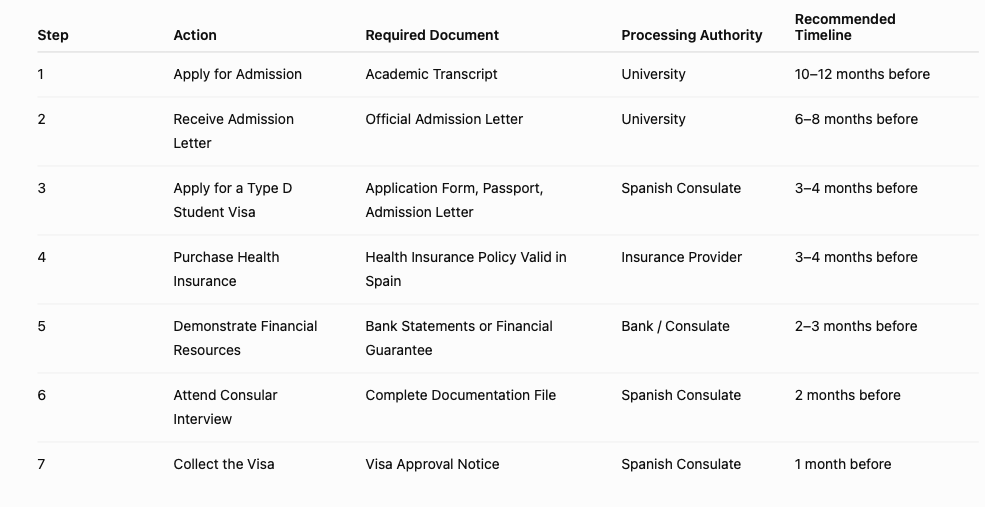
The long-stay type D visa is mandatory for non-EU students, meaning those who do not belong to the EU, EEA, or Switzerland, who will stay in Spain for more than 90 days. The process is carried out entirely at the Spanish consulate or embassy in the country of origin and cannot be started from Spain.
Financial requirements and degree recognition
To obtain a student visa, you must prove sufficient financial solvency to cover living expenses during your stay. As a guideline, the minimum reference amount is around €600-700 per month, although this varies depending on the city and lifestyle.
Degree recognition is the process through which the Spanish education system formally recognizes the validity of your previous studies. It is processed through the Ministry of Education, Vocational Training and Sports, and may require sworn translations, legalization of documents through apostille, and, in some cases, complementary exams. It is essential to start this procedure in parallel with the admission application, as it can take between two and six months.
Student life when studying abroad in Spain
Culture and extracurricular activities
Studying abroad is a life experience that goes far beyond the classroom. Spain offers an extraordinarily rich cultural environment: festivals, internationally recognized gastronomy, an active nightlife, and a wide range of sports and artistic activities. Spanish universities encourage participation in clubs, student associations, and extracurricular activities, making integration easier and helping students build lasting networks of contacts.
In addition, ENAE is located in southeastern Spain, a strategic location with a hard-to-match advantage: Mediterranean quality of life at an accessible cost. During the academic year, the mild and sunny climate fills the streets with life, leisure, and gastronomy, offering a perfect balance between calm and dynamism. The region is becoming a high-value logistics and business hub, with the presence of companies such as Grupo Fuerte and a strategic position within the Mediterranean Corridor, the economic axis connecting southern Spain with Europe. Studying here is not only about training: it means becoming part of a real, international, and growing business ecosystem.
Types of accommodation and how to choose
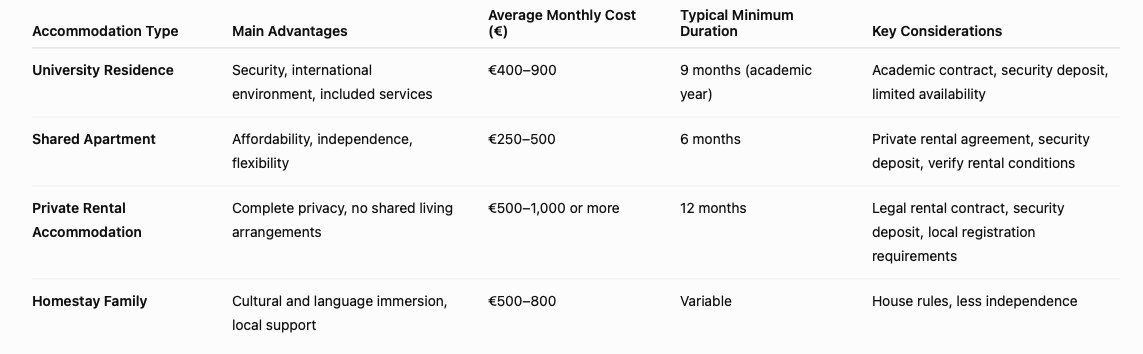
Finding the right accommodation is one of the most important decisions when planning your stay. The main options are:
Labor regulations for international students
International students with a valid student visa may work part-time, usually up to 30 hours per week. Always check the current official regulations, as they may be updated. Employment must be compatible with studies and, in many cases, requires prior authorization. Professional internships managed by the university through an agreement do not count as paid employment and are regulated under the Non-Labor Internship Law.
How to prepare and adapt when studying abroad
Learning Spanish: courses and recommended levels
Although the number of programs in English has grown significantly, an intermediate level of Spanish, B1-B2 according to the Common European Framework of Reference, is highly recommended for everyday life, social relationships, and certain subjects taught in Spanish. Many universities offer intensive Spanish courses before the start of the academic year. There are also digital platforms such as Duolingo, Babbel, or Preply, as well as specialized academies with in-person or online classes.
University integration and support networks
Actively participating in university life from day one is the most effective strategy for successful integration. International student offices offer academic advice, cultural guidance, psychological support, and buddy or local mentor programs. Joining student associations, sports groups, or volunteer initiatives expands your network of contacts and enriches your experience. ENAE supports students even before their arrival to help make adaptation easier.
Calendar and deadlines for studying abroad in Spain
Careful time planning is the difference between a successful experience and a process full of unexpected issues. The following approximate timeline can help you organize your roadmap:
- 10-12 months before: select program and university; begin the degree recognition process.
- 8-10 months before: submit admission applications and prepare complete documentation.
- 6-8 months before: receive admission letter; take out international health insurance.
- 4-6 months before: apply for the type D student visa at the corresponding Spanish consulate.
- 2-4 months before: search for and reserve accommodation; open a bank account if possible.
- 1 month before: confirm enrollment, buy tickets, and prepare travel logistics.
Always check the official deadlines of the university and the corresponding consulate, as they may vary each year.
Roles and career opportunities after studying abroad
The experience of studying abroad directly enhances the student’s professional profile. According to the LinkedIn Talent Report 2026, candidates with international education are 35% more likely to be contacted by international recruiters. The profiles that benefit most from this experience are:
- International managers and executives: exposure to multicultural environments develops global leadership skills, intercultural negotiation, and management of diverse teams.
- Foreign trade and supply chain specialists: knowledge of regulatory systems, languages, and European markets is a differentiating asset in these roles.
- Strategy and management consultants: global firms such as McKinsey, BCG, or Deloitte especially value education at prestigious European institutions.
- Entrepreneurs with international ambition: the network of contacts built during studies abroad facilitates access to investors, partners, and European markets.
- Global marketing and communication professionals: understanding different consumer cultures is key in an environment of global brands.
Postgraduate education as a key step when studying abroad
If your goal is to specialize in business while experiencing studying abroad in Spain, master’s programs represent the most complete option. ENAE Business School, based in Murcia and with more than 37 years of educational experience, offers a portfolio of master’s degrees designed for international students who want to develop a globally oriented career. Its programs in areas such as Business Management, Logistics and Supply Chain, Finance, and Digital Marketing combine academic rigor, a practical approach, and a network of partner companies that facilitates access to the European labor market.
With a case-study-based methodology and faculty members with real executive experience, ENAE Business School offers international students not only a recognized qualification, but also the cultural and professional immersion that makes Spain one of the most valuable destinations for studying abroad. If you are considering taking the international leap in your education, exploring its master’s programs is a solid starting point.
Frequently asked questions about studying abroad in Spain
How far in advance should I apply for a student visa for Spain?
It is advisable to start the type D visa application process at least three to four months before the start date of the program. However, since before applying for the visa you must have the admission letter, the degree recognition process underway, and health insurance contracted, the overall planning should begin ten to twelve months before the expected arrival date.
What documents do I need to validate a foreign degree in Spain?
The recognition process through the Ministry of Education usually requires: valid passport or identity document, original degree with the corresponding academic certificate, sworn translation into Spanish if the document is in another language, legalization through the Hague Apostille or diplomatic channels, and the official application form. Specific requirements may vary depending on the country of origin and the type of qualification.
Can I work in Spain with a student visa?
Yes, with limitations. International students with a valid student visa may work part-time, generally up to 30 hours per week, provided that the job is compatible with their studies. It is necessary to verify the exact conditions in the current regulations and, where applicable, obtain the corresponding authorization. University internships managed through an agreement follow a different regime and do not count as paid employment.
What are the most affordable accommodation options for international students?
A shared apartment is usually the most affordable option, with costs ranging between €250 and €500 per month depending on the city. University residences offer greater security and an international social environment, although at a somewhat higher price, between €400 and €900. In cities such as Murcia, Valencia, or Seville, costs are significantly lower than in Madrid or Barcelona, making them highly competitive destinations for students on a limited budget.
What scholarship programs are available to study abroad in Spain?
ENAE maintains active agreements with official funding bodies in several countries: PRONABEC in Peru, ICETEX in Colombia, MESCYT in the Dominican Republic, and equivalent organizations in Honduras, Ecuador, and other countries in the region. For students from countries without an agreement, ENAE also offers its own scholarships through FUERM. Check with your national organization or directly with ENAE for current calls, as application deadlines vary depending on the country and program.
Does studying abroad really improve job opportunities?
The data is clear: according to the GMAC Corporate Recruiters Survey 2024, 89% of employers value international experience positively in candidates. Studying abroad develops skills such as adaptability, intercultural communication, language proficiency, and autonomy, which are highly valued in global business environments. A master’s degree completed at a leading Spanish business school, combined with internships in local companies, can become a decisive differentiating factor in the international labor market.
With more than 6 years of experience in the higher education sector, she specializes in marketing, communications, social media management, content creation, and event coordination. Her work focuses on developing communication strategies, promoting academic and professional initiatives, and creating meaningful connections between students, professionals, companies, and institutions.
She has contributed to the promotion of programs related to leadership, digital transformation, employability, entrepreneurship, international education, and business development. Passionate about communication and lifelong learning, she combines creativity, strategic thinking, and audience engagement to help bring educational opportunities closer to diverse communities.
Her areas of interest include business trends, innovation, leadership, talent development, higher education, and the evolving relationship between academia and the professional world.
Masters relacionados


Agri-food is a strategic sector for both the national and international economies.



A company or organization that anticipates, identifies needs and threats, foresees, and makes strategic and operational decisions based on Comprehensive Risk Management



In ENAE Business School's Official Master in Logistics and Operations Management program, you will learn how to analyse the performance of a company's operation


The Master in International Trade, E-commerce and AI Concentration is designed to prepare professionals to lead international business operations in a global, d
Artículos recomendados
También te podría interesar leer

Business Intelligence (BI) refers to the technologies, processes and competencies that enable organisations to collect, structure, analyse and visualise data in order to support better-informed business decisions. As organisations generate…

Risk management is the systematic process through which an organization identifies, analyzes, evaluates and responds to uncertainty that could affect the achievement of its objectives. These uncertainties may represent threats, but they can also…

Employability in logistics depends on a professional's ability to combine technical knowledge, digital skills and strategic thinking in response to the changing needs of logistics and supply chain operations. As companies face increasingly complex…
